
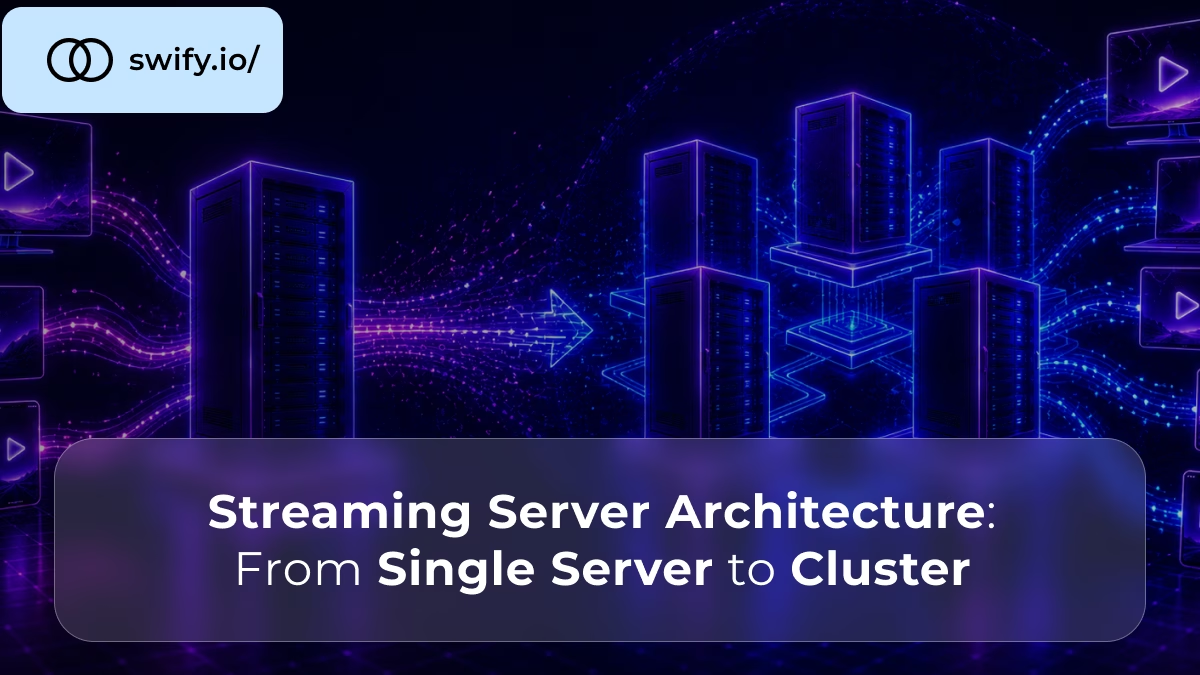
A single dedicated server works well for streaming, until the audience outgrows it. What comes after is not “a bigger server.” It is a genuine architecture decision, and most platforms that get this wrong do not fail gracefully. They buffer, drop viewers, and lose them permanently.
This guide covers how streaming server architecture actually scales, from a single machine handling a few hundred viewers to a full origin-and-edge cluster serving thousands, and what changes at each stage.
📖 Not sure you need dedicated yet?
If you are still weighing whether dedicated infrastructure makes sense for your audience size, read Dedicated Server for Streaming: What 100 Viewers Actually Need, on the bandwidth math behind that decision.
Why Video Breaks Generic Hosting Architecture
Most hosting environments are built for request-response workloads: a user requests a page, the server responds, the connection closes. Video streaming is fundamentally different. A live stream or video-on-demand session holds a connection open for the entire viewing duration, consuming bandwidth continuously rather than in bursts.
This creates infrastructure requirements that shared hosting, VPS environments, and many cloud configurations cannot meet reliably: sustained bandwidth rather than burst capacity, low and consistent latency rather than good average latency, high disk I/O for VOD delivery, and dedicated CPU capacity for real-time transcoding. None of these are optional at scale. Each one, unaddressed, becomes the reason a platform buffers during its busiest moment.
The Noisy Neighbour Problem in Streaming
Shared infrastructure introduces a problem that is manageable for a blog and catastrophic for a video platform: the noisy neighbour effect.
When a streaming server shares physical hardware with other tenants, their workloads compete for CPU scheduling, disk I/O, and network bandwidth. Under heavy load, another tenant’s database backup or traffic spike can degrade network throughput or introduce scheduling delays. For a blog, that might mean a slower page load. For a live stream, it means viewers see a buffering spinner and leave, and viewer abandonment during buffering is rarely recoverable within that session.
Dedicated servers eliminate this entirely. No other tenant shares the CPU, network interface, or storage I/O, so peak streaming hours are not affected by anyone else’s workload.
📖 New to dedicated servers?
Read What Is a Dedicated Server?, a clear breakdown of how dedicated infrastructure works and why it matters for demanding workloads.
Streaming Server Architecture: Three Patterns by Scale
Streaming infrastructure on dedicated servers typically follows one of three patterns, depending on audience size.
Single Dedicated Server: Small to Medium Platforms
For platforms with up to a few hundred concurrent viewers, one high-specification dedicated server handles the full stack: origin storage, transcoding, and delivery. This suits independent creators, podcast video platforms, corporate streaming, and niche VOD services.
Key specifications at this tier: a high-core-count CPU for parallel transcoding (16+ cores recommended), large RAM for buffering and session management (64GB minimum for active streaming), NVMe storage for fast video reads and writes, and a 10 Gbps network port, since a 1 Gbps port saturates quickly under concurrent streaming load.
Origin Plus Edge Architecture: Medium to Large Platforms
As viewer counts grow, a single server becomes the origin, the source of truth for video content, while delivery is distributed via a CDN or additional dedicated edge nodes positioned closer to viewer populations.
The dedicated origin server handles transcoding, storage, and authentication. Edge nodes or CDN points of presence handle actual delivery, reducing latency by serving from locations closer to viewers. Most modern delivery at this tier relies on adaptive bitrate streaming, where the origin encodes video at multiple bitrates and resolutions, and each viewer’s player requests the version their connection can sustain. According to Apple’s own HLS authoring specification, this multi-rendition approach is the foundation of HTTP Live Streaming, the protocol behind the majority of adaptive video delivery today. This architecture lets platforms scale viewer capacity horizontally without upgrading the origin server, while keeping the most expensive infrastructure, transcoding and storage, centralised and manageable.
Full Dedicated Cluster: Enterprise Platforms
At enterprise scale, dedicated servers form a cluster: separate transcoding nodes, separate storage servers, separate delivery nodes, and dedicated database servers for metadata, user management, and analytics. Each layer scales independently based on its specific bottleneck.
Three architecture tiers, by audience scale
Single Server
Up to a few hundred viewers
Origin + transcoding + delivery, one machine
Origin + Edge
Medium to large audiences
Origin centralised, delivery distributed via CDN/edge nodes
Full Cluster
Enterprise scale
Separate transcoding, storage, delivery, and database nodes
Diagram showing three streaming server architecture tiers. Single server for up to a few hundred viewers. Origin plus edge for medium to large audiences. Full dedicated cluster for enterprise scale with separate nodes per function.
📖 How does dedicated infrastructure handle the data layer?
Large streaming platforms run metadata-heavy databases alongside video delivery. Read How Dedicated Servers Support Large Databases & Big Data to understand how dedicated infrastructure handles that layer at scale.
Live Streaming vs Video on Demand: Different Infrastructure Priorities
On-demand and live streaming delivery have different infrastructure profiles, and the distinction shapes how you provision.
Live streaming is latency-first. The gap between what happens on camera and what viewers see must stay minimal, ideally under 5 seconds for interactive streams, under 30 seconds for broadcast-style events. This demands low-latency ingest protocols (RTMP, SRT, WebRTC), real-time transcoding as streams arrive rather than after, and reliable uplink bandwidth with no throttling at peak ingest.
Video on demand is throughput-first. The content already exists on disk and can be pre-transcoded before delivery, so the priority shifts to high-capacity, high-throughput storage, sustained read performance across many simultaneous file reads, effective caching for popular content, and metadata database performance for search and recommendation.
Dedicated Server vs Cloud for Media Streaming: The Cost Reality
Cloud platforms market heavily to streaming use cases, and cloud elasticity is genuinely useful for unpredictable spikes. The cost structure at scale deserves honest examination.
The single largest cloud cost for streaming platforms is egress, the fee charged for data leaving the provider’s network to reach viewers. At low volumes this is manageable. At scale it compounds dramatically: a platform delivering 100TB of video per month, a modest figure for a growing service, faces significant egress costs before compute, storage, and transcoding are even added.
Dedicated servers do not charge egress fees. A dedicated server with a 10 Gbps port and a high-volume bandwidth allocation delivers video without per-gigabyte charges, which frequently represents the largest single infrastructure saving available once a platform outgrows early-stage cloud economics.
📖 Dedicated vs cloud, the full cost breakdown
Read Dedicated Server vs Cloud Hosting: Which Is Right for Your Business in 2026?, a detailed comparison of performance, egress costs, and total infrastructure economics.
What Each Architecture Tier Needs From Hardware
CPU for Transcoding
Software transcoding is CPU-intensive. A server transcoding a live stream into four quality tiers simultaneously can consume 8 to 16 cores at sustained high utilisation. Provision for peak transcoding load, not average load, because viewer counts and transcoding demand peak at the same moment. Hardware acceleration via NVIDIA GPU or Intel QuickSync reduces CPU load significantly for platforms running heavy live transcoding.
Storage for VOD Libraries
A VOD library of 1,000 hours of HD video needs roughly 2 to 4TB for source files alone, more with multiple stored quality tiers. Plan for 3x to 5x raw video storage to account for transcoded versions, thumbnails, and metadata. NVMe for actively served content, high-capacity SATA SSD for the broader library, cold storage for archive content that serves infrequently.
Network Bandwidth
Network requirements scale with architecture tier, not just viewer count. A single server handling delivery directly needs a 10 Gbps port as the practical minimum, since a 1 Gbps port saturates quickly under concurrent streaming load. In an origin-plus-edge setup, the origin’s own bandwidth needs shrink relative to total viewer count, since edge nodes absorb most delivery traffic, but it still needs enough capacity to feed every edge node simultaneously. In a full cluster, each delivery node carries its own high-bandwidth allocation, and the internal network connecting storage to delivery nodes needs dedicated capacity of its own, separate from what reaches viewers.
The allocation model matters as much as raw speed. Unmetered bandwidth with a fair use policy suits platforms with unpredictable spikes; a fixed monthly transfer allowance suits platforms with steady, forecastable demand.
Who Is Using Dedicated Servers for Streaming?
The use cases span a wider range than most people expect. Independent creators and studios running subscription VOD platforms eliminate egress costs and reduce buffering issues. Corporate video platforms for internal communications and training delivery need reliability during scheduled events with predictable audience size. Sports and events streaming, live sports, esports tournaments, and conference streaming, face high peak concurrent viewers within defined windows where buffering is unacceptable. Education platforms serving large video libraries face significant storage costs as a real operational consideration. Podcast video platforms have grown into their own content category with storage and bandwidth needs that outgrow shared hosting quickly.
The Infrastructure Decision for Streaming Platforms
Choosing dedicated server architecture for a media platform is not a premature optimisation. It is the structure that scales with the workload, eliminates the egress costs that make cloud unviable at mid-scale, and removes the resource contention that causes buffering on shared infrastructure.
The question is rarely whether a growing platform will eventually need this architecture. It is whether the transition happens before a buffering crisis during a live event, or after.
Build your streaming platform on the right infrastructure
Swify’s dedicated servers are built for bandwidth-intensive workloads: 10 Gbps ports, NVMe storage, high-core-count CPUs, and European data centres with transparent pricing and no egress fees.
→ Explore Swify Dedicated ServersFrequently Asked Questions
How many concurrent viewers can a dedicated server handle?
It depends on stream bitrate and network port speed. A single well-specified server on a 10 Gbps port can support meaningfully more concurrent viewers than one on a 1 Gbps port, though transcoding overhead and ingest traffic reduce the practical ceiling below the theoretical maximum. For larger audiences, an origin-plus-edge architecture distributes delivery across multiple nodes rather than scaling one server indefinitely.
For the exact bitrate-to-viewer math, read Dedicated Server for Streaming: What 100 Viewers Actually Need.
Do I need a dedicated server for live streaming or can I use a VPS?
A VPS can handle very low concurrent viewer counts, but its shared network interface, limited CPU allocation, and exposure to the noisy neighbour effect make it unreliable for live streaming at any meaningful scale. For live events where buffering is unacceptable, dedicated infrastructure is the appropriate baseline.
Read Dedicated Server vs VPS: Which One Do You Actually Need? for a full comparison.
What is the best storage setup for a VOD platform on a dedicated server?
NVMe drives for actively served content, the videos viewers are currently watching, and high-capacity SATA SSDs for the broader library. Archive content that serves infrequently can move to cost-efficient cold storage. Sustained read throughput across many simultaneous file reads is the key metric, and NVMe handles this significantly better than traditional SSDs.
Read How NVMe Storage Boosts Dedicated Server Performance for a full breakdown.
How does a dedicated server compare to cloud for streaming costs at scale?
The critical difference is egress fees. Cloud providers charge per gigabyte of data delivered to viewers, a cost that compounds dramatically at streaming scale. Dedicated servers with high-volume bandwidth allocations eliminate this per-gigabyte charge entirely, which frequently represents the largest cost saving available for platforms delivering tens of terabytes per month.
Read Dedicated Server vs Cloud Hosting: Which Is Right for Your Business in 2026? for the full cost comparison.
What CPU specification do I need for live video transcoding?
Software transcoding a live stream into four adaptive bitrate tiers simultaneously can consume 8 to 16 CPU cores at sustained high utilisation. A minimum of 16 cores is recommended for any platform running real-time transcoding alongside delivery. Hardware acceleration via NVIDIA GPU or Intel QuickSync reduces CPU load and increases throughput for platforms with heavy transcoding requirements.
Read How to Choose the Best Hardware for Your Dedicated Server for a guide to matching hardware specs to your workload.
How do I secure a streaming server handling user content and payments?
Streaming platforms handling user accounts and payments require DDoS protection, strict firewall rules, encrypted storage for user data, and regular security audits. Physical isolation on a dedicated server eliminates the cross-tenant vulnerabilities that exist on shared infrastructure.
Read Best Security Practices for Dedicated Server Environments for a complete security checklist.