
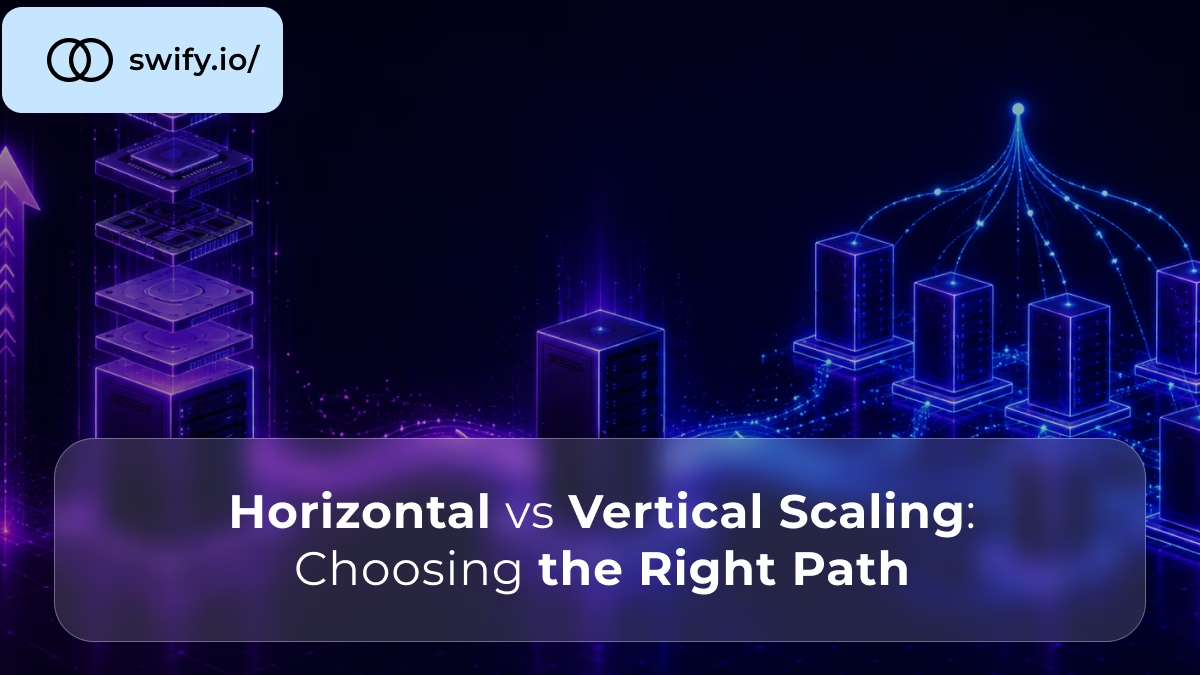
Every growing infrastructure eventually hits the same fork in the road. Traffic grows, the database slows, and someone asks the question: do we get a bigger server, or do we get more servers? This is the horizontal vs vertical scaling decision, and it is, at its core, a question about money and failure modes, not about technology preferences.
This guide focuses on that decision: what each path actually costs as you grow, the signals that tell you which one fits your situation, and why most serious infrastructure eventually needs both, applied to different parts of the same system.
📖 The mechanics of horizontal scaling
This guide covers the decision. For how traffic actually gets distributed once you choose horizontal, read Server Load Balancing: How to Scale Beyond One Server, on the algorithms and load balancer types behind it.
What Horizontal and Vertical Scaling Actually Mean
Vertical scaling means making one machine bigger: more CPU cores, more RAM, faster storage, all on the same dedicated server. The application and its data stay in one place. Nothing about the architecture changes, only the size of the box running it.
Horizontal scaling means adding more machines and distributing the workload across them. Instead of one larger server, the load spreads across several, coordinated by a load balancer. The architecture changes: the application now has to work correctly across multiple instances, which is not automatic.
Neither path is inherently better. They fail differently, cost differently, and suit different situations, which is exactly why this decision deserves more thought than “scale horizontally, everyone does.”
The Real Cost Curves
Vertical scaling has a cost curve that is easy to reason about, because it is mostly linear within a provider’s catalogue, and it has a hard ceiling.
Take Swify’s own range as an illustration: a Dedicated 1 with a single Xeon Gold 5215 and 64GB RAM starts at €120 a month. Moving up through the range to a Dedicated 8, dual Xeon Gold 6138 processors and 256GB RAM, reaches €320 a month. Each step up costs more, predictably, until you reach the ceiling of what a single machine can physically hold. Past that ceiling, vertical scaling is no longer an option, regardless of budget.
Horizontal scaling has no equivalent hard ceiling. You can, in principle, keep adding servers indefinitely. What it introduces instead is a different kind of cost, one that does not show up on a single invoice line. Coordinating multiple servers requires a load balancer, network overhead between nodes, and often duplicated resources for redundancy. According to Google’s own Site Reliability Engineering documentation, effective capacity planning models systems around actual measured resource consumption rather than simple request counts. That same principle explains why distributed capacity is harder to reason about than a single machine’s specifications: coordinating resource limits across several servers is a fundamentally different problem than reading the specification sheet of one.
Two different cost shapes
| Vertical | Horizontal | |
|---|---|---|
| Cost predictability | High, one line item | Lower, coordination overhead |
| Growth ceiling | Hard limit, biggest available machine | No hard limit |
| Architecture impact | None | Application must support multiple instances |
Vertical scaling is simpler and predictable up to a ceiling. Horizontal scaling removes the ceiling at the cost of coordination complexity.
Table comparing vertical and horizontal scaling across cost predictability, growth ceiling, and architecture impact. Vertical scaling has high cost predictability but a hard growth ceiling. Horizontal scaling has no ceiling but requires the application to support multiple instances.
📖 What actually breaks under load
Read Understanding Server Load: How Dedicated Servers Handle High Traffic, on the specific resource constraints, CPU, memory, disk I/O, network, that force this decision in the first place.
The Signals That Tell You Which Path You Need
Rather than a rule, this decision responds to a handful of concrete signals worth checking against your own situation.
Signals favouring vertical scaling: the bottleneck is a single resource, CPU, RAM, or storage speed, and a bigger machine directly relieves it. The workload does not tolerate being split, a relational database with strict consistency requirements is the clearest example. Your team is small, and the operational simplicity of one machine matters more than theoretical headroom. Growth has been steady and forecastable, not spiky.
Signals favouring horizontal scaling: you have already reached the largest machine your provider offers, and the bottleneck persists. The workload is naturally distributable, stateless web or application servers handling independent requests are the clearest example. Redundancy matters as much as raw capacity, since a second server also means the first one can fail without taking the whole system down. Growth is unpredictable or spiky, and elastic capacity matters more than the simplicity of a single box.
Why Serious Infrastructure Usually Ends Up Doing Both
The honest answer, once a system is genuinely under sustained growth, is rarely “we chose horizontal” or “we chose vertical.” It is both, applied to different layers.
The application tier, stateless web servers handling independent requests, is usually the easiest part of a system to scale horizontally. Adding another server behind a load balancer requires no fundamental redesign, because each request is independent of the others.
The database tier resists horizontal scaling for a structural reason: consistency. A relational database that splits data across multiple machines has to solve hard problems around keeping that data correct and current everywhere at once, problems that stateless application servers simply do not have. This is why database tiers are frequently scaled vertically, a larger machine with more RAM to hold the working dataset in memory, for far longer than the application tier stays on a single box.
📖 How large databases actually scale
Read How Dedicated Servers Support Large Databases & Big Data, on why the database layer plays by different rules than the rest of the stack.
This split, vertical database, horizontal application tier, is not a compromise. It is usually the correct architecture, because it matches each layer’s scaling approach to what that layer can actually tolerate.
When the Decision Becomes Urgent
A few concrete moments tend to force this decision rather than leave it theoretical: performance degrades specifically during traffic peaks rather than consistently, which points toward needing more capacity somewhere, not a code fix. You have already upgraded to the largest single server your provider offers, and the bottleneck has not moved. A single point of failure has caused an outage, and the business cost of that outage now exceeds the cost of redundancy.
None of these moments mean something went wrong. They mean the system succeeded past the point its original scaling path was built for.
Room to scale, either way
Swify’s range runs from single-socket Dedicated 1 at €120/month to dual-socket Dedicated 8 at €320/month, so vertical scaling has real headroom before you ever need a second server. Full root access, enterprise SSD and NVMe storage, 1Gbps unmetered bandwidth.
→ Explore Swify Dedicated ServersFrequently Asked Questions
What is the difference between horizontal and vertical scaling?
Vertical scaling means increasing the resources of a single server, more CPU, RAM, or faster storage, without changing the architecture. Horizontal scaling means adding more servers and distributing the workload across them, which requires the application to support running across multiple instances. Vertical scaling is simpler but has a hard ceiling at the largest available machine; horizontal scaling has no such ceiling but introduces coordination complexity.
Read What Is a Dedicated Server? for the foundation this decision builds on.
When should I scale vertically instead of horizontally?
Vertical scaling fits best when the bottleneck is a single resource that a bigger machine directly relieves, when the workload does not tolerate being split, a relational database is the clearest example, and when operational simplicity matters more than theoretical headroom. It also suits steady, forecastable growth rather than unpredictable spikes.
Read How to Choose the Best Hardware for Your Dedicated Server for how to size that single machine correctly.
Why do databases scale differently from application servers?
Application servers handling independent requests can usually be duplicated behind a load balancer without any fundamental redesign. Databases resist this because of consistency: data split across multiple machines has to stay correct and current everywhere at once, a genuinely hard problem that stateless servers do not face. This is why database tiers are frequently scaled vertically, with a larger machine and more RAM, long after the application tier has moved to multiple servers.
Read How Dedicated Servers Support Large Databases & Big Data for the fuller picture.
Is there a limit to how much I can scale vertically?
Yes, a hard one: the largest single machine available. Once you reach that ceiling, whatever it is on your provider’s range, vertical scaling stops being an option regardless of budget, and horizontal scaling becomes the only remaining path for further growth.
Read When Should You Upgrade to a Dedicated Server? for the signals that tell you when you are approaching that ceiling.
Do I need a load balancer to scale horizontally?
Yes, in practice. Once traffic is distributed across more than one server, something has to decide which server handles each incoming request, and do so in a way that survives an individual server going down. That is the role a load balancer plays.
Read Server Load Balancing: How to Scale Beyond One Server for the algorithms and load balancer types involved.
Can I switch from vertical to horizontal scaling later?
Yes, and it is a common path. Most systems start on a single server and scale vertically for as long as that remains simple and sufficient. The switch to horizontal scaling, at least for the application tier, typically happens once vertical headroom runs out or redundancy becomes a genuine requirement, not before.
Read Dedicated Server Migration Checklist for how to plan that transition without downtime.