
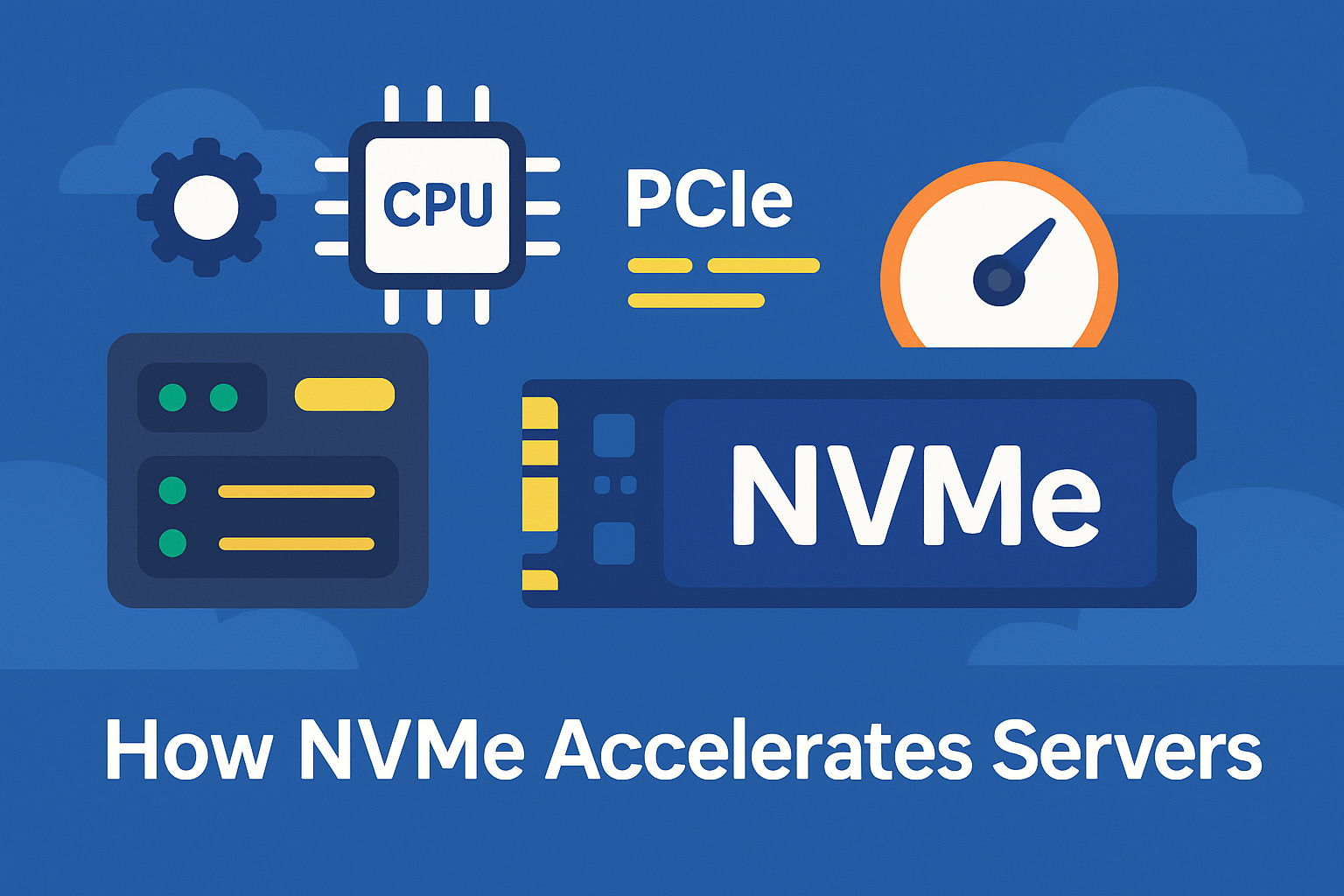
In modern hosting environments, storage speed is one of the most influential factors that determines how fast a server can process data, load applications, and respond to user requests. While traditional SSDs already offer significant improvements over HDDs, NVMe storage represents the next major leap in server performance, especially for dedicated server setups.
NVMe (Non-Volatile Memory Express) is a storage protocol designed specifically to leverage the parallelism and low latency of modern flash memory. For businesses that require high throughput, fast response times, and consistent performance, NVMe-powered dedicated servers deliver a noticeable competitive advantage.
Running performance-critical workloads?
Discover why NVMe storage has become the standard for high-performance dedicated server
What Is NVMe and Why Does It Matter?
NVMe is a communication protocol built to replace older standards such as SATA and SAS, which were originally created for mechanical hard drives. Unlike these legacy interfaces, NVMe connects directly over PCI Express (PCIe), eliminating bottlenecks and allowing data to move much more quickly.
Key Characteristics of NVMe:
- Extremely low latency
- High input/output operations per second (IOPS)
- Parallel command queues (instead of single-queue limitations)
- Direct PCIe communication with the CPU
These features allow NVMe drives to handle significantly more requests at faster speeds.
How NVMe Improves Dedicated Server Performance
1. Dramatically Lower Latency
NVMe drives operate with microsecond-level latency, which is far lower than SATA SSDs.
Benefits:
- Faster application response
- Reduced page load time
- Faster data retrieval for databases and APIs
2. Higher IOPS for Heavy Workloads
NVMe can handle tens of thousands of parallel requests, making it ideal for resource-intensive environments.
Ideal for:
- High-traffic websites
- Large-scale e-commerce systems
- Real-time applications
- Virtualization platforms
3. Greater Bandwidth Through PCIe
Because NVMe runs on PCIe lanes, it achieves much higher throughput than SATA-based drives.
Results include:
- Faster file transfers
- Smoother data streaming
- Improved performance under peak load
4. Better Performance for Databases
Databases often perform thousands of read/write operations per second. NVMe drastically reduces bottlenecks.
Enhancements include:
- Faster indexing
- Faster transaction processing
- Lower query response times
Platforms like MySQL, PostgreSQL, and MongoDB benefit significantly from NVMe storage.
Want to understand how storage performance impacts overall server speed?
Learn how dedicated servers handle heavy workloads and traffic spikes.
5. Superior Multitasking and Parallel Processing
With support for multiple queues and commands, NVMe can process more tasks simultaneously.
Great for servers running:
- Multiple virtual machines
- Containers (Docker, Kubernetes)
- Background tasks + user-facing applications
- High-concurrency applications
Use Cases That Benefit the Most from NVMe
NVMe storage is ideal for industries or workloads that demand real-time performance, including:
- SaaS platforms
- Financial applications
- Gaming servers
- AI/ML workloads
- Content management systems (CMS)
- Video streaming platforms
- Big data analytics
If your application relies heavily on read/write operations, NVMe provides an immediate performance upgrade.
Not all workloads benefit equally from NVMe.
Explore when dedicated servers are the right choice for high-performance environments.
How NVMe Enhances User Experience
Even if your users don’t understand the technical details, they will feel the difference:
- Faster page loads
- Reduced latency during peak hours
- Smoother interactive applications
- Higher reliability and fewer timeouts
These benefits directly improve conversion rates, retention, and customer satisfaction.
Is NVMe Worth the Investment?
For most modern workloads, yes. NVMe has become the performance standard for dedicated servers, offering:
- Better long-term scalability
- Stronger performance under pressure
- Faster data handling
- Improved ROI for mission-critical applications
If your server hosts growing, performance-sensitive workloads, NVMe storage is a highly recommended upgrade.
So…
NVMe storage is not just an incremental improvement over SSDs—it’s a new performance tier designed for the future of hosting. When combined with a dedicated server’s isolated resources, NVMe provides unmatched speed, stability, and responsiveness.
For businesses aiming to scale, reduce latency, or handle heavy workloads, NVMe-powered dedicated servers deliver the foundation needed to stay competitive.
NVMe storage is a key performance layer, but it works best with the right infrastructure.
Explore how dedicated servers combine isolated resources and high-speed storage for consistent performance.
High-performance storage needs the right infrastructure.
At Swify, we design dedicated server environments with NVMe storage, isolated resources, and predictable performance for demanding workloads.
Key Words
NVMe storage dedicated servers | NVMe storage benefits
dedicated server storage performance | high-performance dedicated servers |
low latency server storage | NVMe hosting performance | PCIe storage
high IOPS workloads | storage latency | database performance optimization
server throughput | parallel processing | enterprise storage solutions
Tags
#NVMeStorage #DedicatedServers #ServerPerformance #HighPerformanceHosting
#EnterpriseHosting #LowLatency #ScalableInfrastructure #HostingTechnology
#WebPerformance #DatabaseOptimization #InfrastructureOptimization