
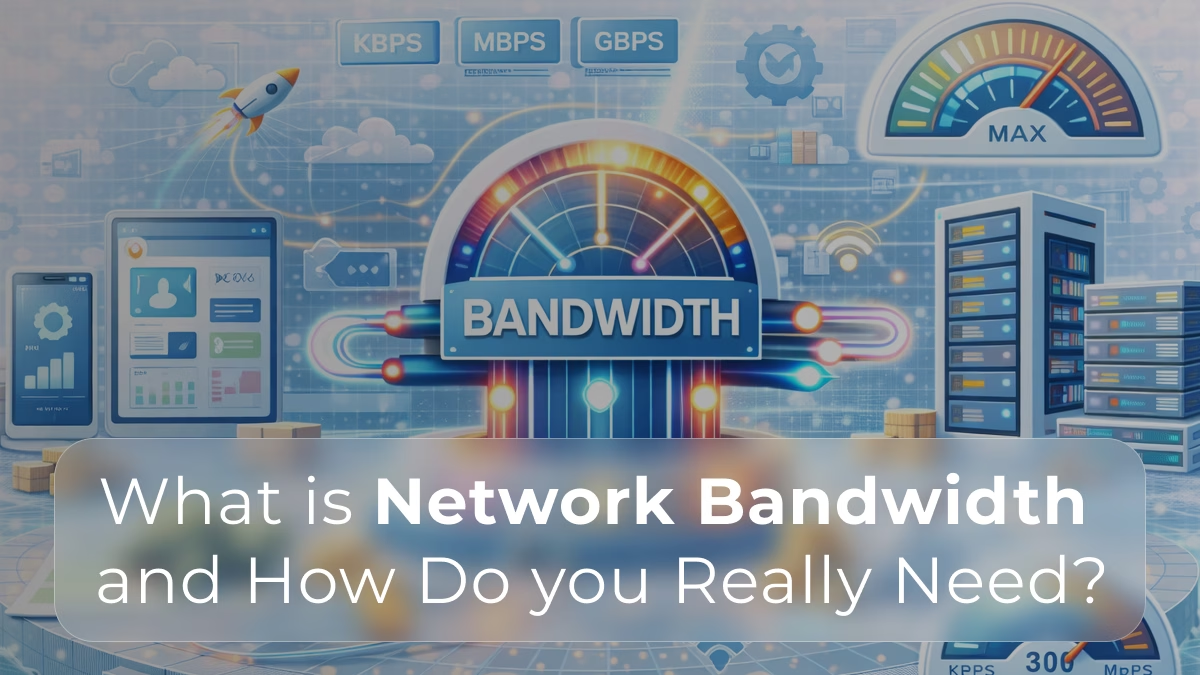
A server with powerful hardware and well-optimised software can still disappoint users if the network connection carrying data between the server and the internet cannot keep up with demand. Network bandwidth is the capacity of that connection, how much data it can carry simultaneously, and getting it wrong in either direction creates problems.
Too little bandwidth and the server becomes a bottleneck: requests queue, downloads slow, streaming buffers, and users experience the site as sluggish even though the server hardware is perfectly adequate. Too much bandwidth, and you are paying for capacity that is never used.
This guide explains what network bandwidth is, what uses it, how to estimate how much your workload requires, and what the relationship between bandwidth and other performance variables actually looks like.
📖 Bandwidth is one component of network performance
Bandwidth determines how much data travels, latency determines how quickly it gets there. Read Latency Explained: Why Dedicated Servers Improve Global Delivery, a complete breakdown of how latency and bandwidth interact to determine the actual user experience of network performance.
What Network Bandwidth Is
Network bandwidth is the maximum amount of data that a network connection can transfer per unit of time. Servers measure it in megabits per second (Mbps) or gigabits per second (Gbps). A server connected to a 1 Gbps network port can theoretically transfer up to 1 gigabit: 125 megabytes, of data every second.
Bandwidth is capacity, not speed. The distinction matters. A highway with six lanes has high capacity; the actual speed of any individual car depends on traffic conditions, road quality, and other factors. Bandwidth is the six-lane highway. The speed at which any individual user’s data arrives depends on bandwidth plus latency, routing quality, and server processing time.
A server with a 1 Gbps uplink and 1,000 concurrent users downloading simultaneously divides that capacity among all of them. Each user receives roughly 1 Mbps if the bandwidth is fully utilised, sufficient for most content, but not for HD video streaming, which requires 5 to 8 Mbps per viewer.
This is the central dynamic of bandwidth management: shared capacity divided among concurrent users, with each user’s experience determined by how much of that capacity their activity requires at any given moment.
Bandwidth vs Latency: Two Different Performance Variables
Addressing the topic Bandwidth and latency, both are network performance metrics, but they address different limitations and are frequently confused.
Bandwidth – the capacity of the network connection, measured in Mbps or Gbps. Bandwidth determines how much data can travel simultaneously. High bandwidth allows many users to transfer data at the same time without each degrading the others’ experience.
Latency – the time data takes to travel from one point to another, measured in milliseconds. Latency determines how quickly a request completes. Low latency makes interactions feel fast; high latency makes them feel slow, even on high-bandwidth connections.
The relationship between the two is not substitutable. High bandwidth does not compensate for high latency. A page that makes 30 individual requests, each requiring a round trip to the server, on a high-bandwidth but high-latency connection will load more slowly than the same page on a lower-bandwidth but low-latency connection — because each round trip pays the latency cost, and bandwidth does not reduce that cost.
Conversely, high latency does not compensate for insufficient bandwidth. A large file download on a fast, low-latency connection but constrained bandwidth will take longer than on a slow, high-latency connection with ample bandwidth.
Both matter, and optimising one without the other leaves half the performance problem unaddressed.
What Consumes Bandwidth on a Server
Every interaction between users and the server transfers data. Understanding the major bandwidth consumers clarifies where demand comes from and where optimisation has the most impact.
Web Page Asset Delivery
Every page load transfers resources from the server to the user’s browser: HTML, CSS, JavaScript files, images, fonts, and video elements. Modern web pages are significantly larger than those of a decade ago, a typical e-commerce product page may transfer several megabytes of combined assets per load.
Multiplied across hundreds or thousands of simultaneous page views, asset delivery becomes the largest bandwidth consumer for most content-serving websites.
File Downloads
Applications that allow users to download files: software packages, documents, exports, media, generate high bandwidth demand per transfer. A single 500MB software download requires the same bandwidth for its duration as hundreds of simultaneously active page views. Platforms with many concurrent file downloads need substantially more bandwidth than those serving only web pages.
Video and Audio Streaming
Streaming requires continuous data transfer for the duration of playback. HD video typically requires 5 to 8 Mbps per stream; 4K video requires 15 to 25 Mbps per stream. A streaming platform with 100 concurrent HD viewers consumes 500 to 800 Mbps, close to the full capacity of a 1 Gbps port — before any other traffic is counted.
Streaming is the most bandwidth-intensive common workload, and platforms serving video content at scale need either very high bandwidth ports or CDN offloading for the majority of their video delivery.
API Traffic
Modern applications generate continuous API traffic: requests between web clients, mobile apps, backend services, and third-party integrations. Individual API requests transfer small amounts of data, but at high frequency across many concurrent users, the aggregate bandwidth demand is meaningful.
High-frequency API platforms: real-time data feeds, live dashboards, trading systems, generate more bandwidth per user than content sites, because every user action triggers a server round trip rather than a browser rendering cached content.
Background Data Transfers
Servers perform data transfers that are not directly user-facing: remote backups transferring gigabytes to offsite storage, database replication sending write logs to secondary servers, log shipping, and monitoring data collection. These background transfers compete with user-facing traffic for bandwidth and should be accounted for in bandwidth planning, and ideally scheduled during off-peak hours to avoid competing with user traffic.
📖 How does high bandwidth demand affect server load?
Network saturation affects not just transfer speeds but server-level performance. Read What Is Server Load and Why Websites Slow Down, including how network constraints manifest alongside CPU, memory, and storage bottlenecks.
How Much Bandwidth Different Workloads Require
Bandwidth requirements vary enormously by workload type. The following are realistic estimates for common server use cases, based on sustained traffic rather than theoretical peaks.
Small Business Websites
A small business website with primarily static content: product information, contact details, a blog, and moderate traffic typically requires 1 to 10 Mbps of sustained bandwidth. Monthly transfer volume is usually in the range of 50 to 200 GB.
At this scale, bandwidth is rarely the constraining resource. A standard hosting connection handles the demand comfortably, and bandwidth monitoring is straightforward.
Content Websites and Blogs
Image-heavy content sites with moderate to high traffic generate more sustained bandwidth demand: typically 10 to 50 Mbps, with monthly transfer volumes of 200 GB to 1 TB. Traffic spikes when popular content drives sudden bursts of concurrent visitors can temporarily push demand significantly above the sustained average.
E-Commerce Platforms
Online stores with product images, dynamic pricing, checkout flows, and payment gateway integrations typically require 50 to 200 Mbps sustained bandwidth. Promotional campaigns: Black Friday, flash sales, can push peak demand five to ten times above the daily average, making bandwidth headroom important for these workloads.
SaaS Applications
SaaS platforms generate continuous bidirectional data transfer: API requests, real-time updates, data synchronisation, dashboard refreshes. Requirements range from 100 Mbps for moderate-scale platforms to 1 Gbps or above for large-scale applications with many concurrent active users.
Unlike content sites, SaaS bandwidth demand correlates directly with active session count, more active users means more simultaneous API calls regardless of caching.
Media and Streaming Platforms
Video streaming platforms require the highest sustained bandwidth of any common workload. A platform serving 100 concurrent HD streams needs 500 to 800 Mbps for video delivery alone. At 1,000 concurrent streams, the requirement exceeds what a single 1 Gbps port can deliver.
Streaming platforms at scale use CDN delivery for video content, offloading the vast majority of bandwidth demand to the CDN’s edge network rather than the origin server. The origin server handles encoding, metadata, and authentication; the CDN handles delivery.
Bandwidth Pricing Models: What to Look For
Dedicated server providers offer bandwidth in different pricing structures, and the model affects total cost significantly for data-intensive workloads.
Unmetered bandwidth on a specified port – a common model where you receive a network connection at a defined port speed (100 Mbps, 1 Gbps, 10 Gbps) with no cap on total data transfer volume. Billing is for the port speed, not the data transferred. This model provides cost predictability for high-volume workloads.
Metered transfer with a monthly allowance – a defined monthly data transfer allowance, with charges for usage above the limit. Common for lower-bandwidth workloads where actual transfer volume is well below the port speed.
95th percentile billing – a model common in colocation and higher-end dedicated server arrangements where billing is based on the 95th percentile of bandwidth usage samples taken throughout the month. The top 5% of usage spikes are excluded from the calculation, allowing occasional bursts without paying peak prices for sustained capacity.
For content-heavy workloads with significant monthly transfer volume, unmetered bandwidth on a specified port is typically more economical than metered billing. For low-traffic workloads, metered allowances often provide a lower base price.
Reducing Bandwidth Consumption
Not all bandwidth demand needs to hit the origin server. Several techniques reduce how much bandwidth the origin server handles directly.
CDN Offloading
A Content Delivery Network caches static assets: images, CSS, JavaScript, video, at edge nodes close to users and serves them directly, without the request reaching the origin server. CDNs can handle the majority of a content site’s bandwidth demand, leaving only uncacheable dynamic content to the origin.
For media platforms specifically, CDN delivery is not a nice-to-have but a requirement at scale. No single dedicated server can serve hundreds of simultaneous video streams economically; CDN delivery distributes that load across a global edge network.
Image and Media Optimisation
Serving appropriately sized and compressed images significantly reduces per-page-load bandwidth consumption. A product image served at 4 MB can often be reduced to 200 KB with appropriate compression and format selection (WebP, AVIF) with no visible quality difference. Across thousands of page loads per day, the bandwidth reduction is substantial.
HTTP Compression
Enabling gzip or Brotli compression on text-based responses: HTML, CSS, JavaScript, JSON API responses, typically reduces transfer size by 60 to 80%. Most web servers and browsers support compression natively; enabling it requires minimal configuration and provides immediate bandwidth savings.
Caching Headers
Proper HTTP cache headers instruct browsers to store resources locally and reuse them on subsequent visits rather than re-downloading them. A returning visitor whose browser has cached your CSS and JavaScript files transfers significantly less data than a first-time visitor. Well-configured browser caching reduces repeat-visitor bandwidth consumption substantially.
Efficient API Design
APIs that return only the data the client actually needs, rather than full objects where only a few fields are used, reduce API bandwidth consumption. Pagination for large result sets, sparse fieldsets, and appropriate use of HTTP caching for API responses all reduce the aggregate bandwidth that API traffic generates.
📖 How does a CDN reduce bandwidth demand on your server?
CDN offloading is the most effective technique for reducing origin server bandwidth consumption. Read What Is a Content Delivery Network (CDN) and Why Your Site Needs It, including how CDN caching interacts with your origin server and what it does and does not reduce.
Dedicated servers with high-capacity network connections
Swify dedicated servers are provisioned with high-capacity network ports and strong IXP peering, giving your workload the bandwidth and network quality it needs without shared connections that other tenants saturate.
→ Explore Swify Dedicated ServersFrequently Asked Questions
What is the difference between bandwidth and internet speed?
Bandwidth is the maximum capacity of a network connection, the largest amount of data it can carry per second. Internet speed is the actual rate at which data transfers at a given moment, which is influenced by bandwidth, latency, server load, network congestion, and routing quality.
A server with a 1 Gbps connection can theoretically transfer 1 Gbps of data per second. In practice, actual transfer speed depends on how much of that capacity is already occupied by other traffic, the latency of the connection path, and the server’s ability to generate data fast enough to fill the pipe. High bandwidth enables high speed when other conditions are favourable, but high bandwidth alone does not guarantee high speed in all circumstances. Read more about how latency interacts with bandwidth in Latency Explained: Why Dedicated Servers Improve Global Delivery.
How much bandwidth does a dedicated server need?
Requirements vary significantly by workload type. A small business website with moderate traffic needs 1 to 10 Mbps sustained bandwidth. A content site or blog typically needs 10 to 50 Mbps. An e-commerce platform needs 50 to 200 Mbps. A SaaS application requires 100 Mbps to 1 Gbps depending on concurrent user count. A video streaming platform may need multiple Gbps or CDN offloading for video delivery.
The most accurate way to determine your requirement is to measure current bandwidth consumption during peak periods and add 30 to 50% headroom for growth and traffic spikes. Monthly bandwidth reports from your current hosting provider or web analytics tools that estimate page weight multiplied by pageviews can give you a baseline estimate for planning purposes.
Does shared hosting limit bandwidth?
Yes, in two ways. Shared hosting plans typically include a monthly bandwidth allowance, a cap on total data transfer, above which additional charges apply or service is throttled. Beyond this, the underlying network connection is shared among many tenants, meaning another tenant’s high-bandwidth activity can reduce the network capacity available to your workload at any given moment.
On a dedicated server, the network port is exclusively yours. No other tenant shares the connection, so your workload has access to the full rated capacity of the port consistently. For bandwidth-sensitive workloads: media platforms, high-traffic sites, SaaS applications, exclusive network access removes a variable that shared environments cannot eliminate. Read more about the performance differences in Dedicated Server vs VPS: Which One Do You Actually Need?
Can a CDN reduce the bandwidth my server uses?
Yes, significantly for cacheable static content. A CDN caches images, CSS, JavaScript, and other static assets at edge nodes globally and serves them directly to users without the request reaching the origin server. Each request served from the CDN edge consumes CDN bandwidth rather than origin server bandwidth.
For a content-heavy website with many static assets, CDN offloading can reduce origin server bandwidth consumption by 70 to 90%. For a video streaming platform, CDN offloading is essential at scale, no single dedicated server can serve hundreds of simultaneous video streams economically from its own network connection. Read more about how CDNs work in What Is a Content Delivery Network (CDN) and Why Your Site Needs It.
Does bandwidth affect Time to First Byte?
Bandwidth affects TTFB primarily when the network connection is saturated. When a server’s uplink is fully occupied, new requests must wait for existing transfers to complete before beginning their own, directly increasing TTFB for those requests. At normal utilisation levels, bandwidth does not significantly contribute to TTFB, because there is sufficient capacity to handle incoming requests without queuing.
The TTFB components that matter most under normal conditions are DNS resolution time, TCP and TLS connection establishment, and server processing time, not bandwidth. Bandwidth becomes the TTFB bottleneck specifically when network saturation occurs, which is why adequate bandwidth headroom is important for high-traffic workloads. Read more about the components of TTFB in What Is Time to First Byte (TTFB) and Why It Matters.
What happens when a server runs out of bandwidth?
When a server’s network connection reaches its capacity ceiling, several things happen depending on the hosting model. On metered bandwidth plans, the provider may throttle transfer speed, charge overage fees, or in some cases suspend service temporarily until the billing period resets. On unmetered plans with a defined port speed, the connection simply saturates, all users sharing the saturated connection experience slower transfers simultaneously.
Bandwidth saturation from a DDoS attack produces a specific form of this problem: the connection fills with attack traffic, leaving no capacity for legitimate user requests. The site becomes unreachable not because the server is down, but because the network pipe is full. DDoS mitigation services address this by filtering attack traffic upstream before it reaches the server’s connection. Read more about DDoS and bandwidth in What Is a DDoS Attack and How Does It Affect Your Website?